
Physicists Discover New Way To Connect Qubits Via Diamond
From University of Chicago
A new study suggests that crystal defects in diamond may hold the key to scalable quantum interconnects.
Connecting large numbers of quantum bits (qubits) into a working technology remains one of the biggest obstacles facing quantum computing. Qubits are extraordinarily sensitive, and even small disturbances can disrupt the quantum states that give these systems their power.
New theoretical research published in npj Computational Materials points to an unexpected solution: using defects inside crystals not as problems to eliminate, but as structural features that could help organize and link qubits at scale.
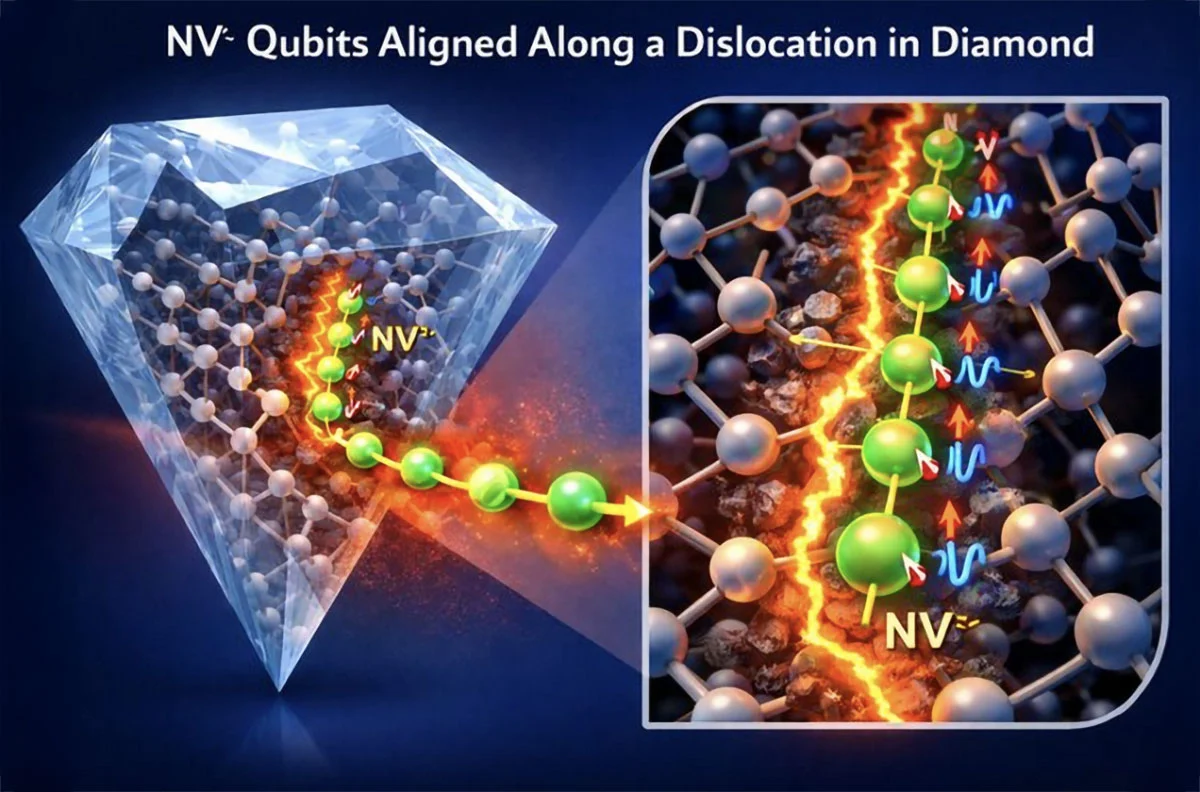
In the study, researchers show that crystal dislocations, which are extended line defects that run through a material, can act as natural gathering points for qubits. Rather than degrading quantum performance, these defects may provide a stable framework for building quantum connections.
The work suggests that dislocations could function as the backbone of future quantum devices, guiding qubits into orderly arrangements while preserving their fragile behavior.
The research team, led by Prof. Maryam Ghazisaeidi at The Ohio State University and Prof. Giulia Galli at the University of Chicago Pritzker School of Molecular Engineering (UChicago PME) and Chemistry Department, focused on nitrogen-vacancy (NV) centers in diamond.
These atomic-scale defects are among the most promising solid-state qubit platforms because they can be controlled and read out using light. Using detailed first-principles simulations, the researchers found that NV centers are naturally drawn toward dislocations in the crystal lattice. Once near these line defects, the qubits can maintain their quantum properties and, in some configurations, perform even better than they do in an otherwise perfect diamond.
“Because dislocations form quasi-one-dimensional (1D) structures extending through a crystal, they provide a natural scaffold for arranging qubits into ordered arrays,” said co-first author Cunzhi Zhang, a UChicago PME staff scientist in the Galli Group.
A Collaborative, Computation-Driven Effort
Supported by funding from the Air Force, the project combined expertise from UChicago and Ohio State across materials science, mechanical engineering, quantum information science, and high-performance computing.
The computational work relied on GPU-accelerated, massively parallel simulation tools developed through the Midwest Integrated Center for Computational Materials (MICCoM). MICCoM is a Department of Energy-funded computational materials science center based at Argonne National Laboratory and directed by Galli, and its software capabilities made it possible to model the complex behavior of quantum defects associated with dislocations in unprecedented detail.
“These unprecedented large-scale first-principles calculations made it possible to accurately model the complex quantum properties of defects at 1D dislocation cores,” said co-first author Victor Yu, staff scientist at Argonne National Laboratory and a MICCoM principal investigator.
The study revealed that many NV centers near dislocation cores remain stable in the desired charge and spin state and preserve a viable optical cycle, enabling optical initialization and readout of their spin states.
“Importantly, we predicted that specific NV configurations near dislocations exhibit significantly enhanced quantum coherence times compared to NV centers in pristine diamond,” Ghazisaeidi said.
This improvement arises from symmetry breaking near the dislocation, which creates specific states, called “clock transitions,” that protect the qubit from environmental magnetic noise.
Guiding Experiments and Future Devices
Beyond establishing stability and coherence, the work provided detailed predictions of optical and magnetic resonance signatures that can guide experimental identification of useful NV–dislocation configurations.
“While not all defect arrangements are suitable for quantum operations, the results show that a substantial fraction meet the requirements for qubit functionality,” said co-author Yu Jin, who was a graduate student at UChicago at the time of the research and now is a postdoctoral research fellow at the Flatiron Institute in New York.
Altogether, the findings of the study introduce a new paradigm for quantum device design: using dislocations not as defects to eliminate, but as quantum highways that can host and facilitate chains of interacting qubits. The approach opens a path toward scalable quantum interconnects in diamond and potentially other materials, offering a promising strategy for future solid-state quantum technologies.
Reference: “Towards dislocation-driven quantum interconnects” by Cunzhi Zhang, Victor Wen-zhe Yu, Yu Jin, Jonah Nagura, Sevim Polat Genlik, Maryam Ghazisaeidi and Giulia Galli, 9 January 2026, npj Computational Materials.
DOI: 10.1038/s41524-025-01945-3
Funding: This work was supported by the AFOSR Grant No. FA9550-23-1-0330.
