
Cooling the Final Frontier
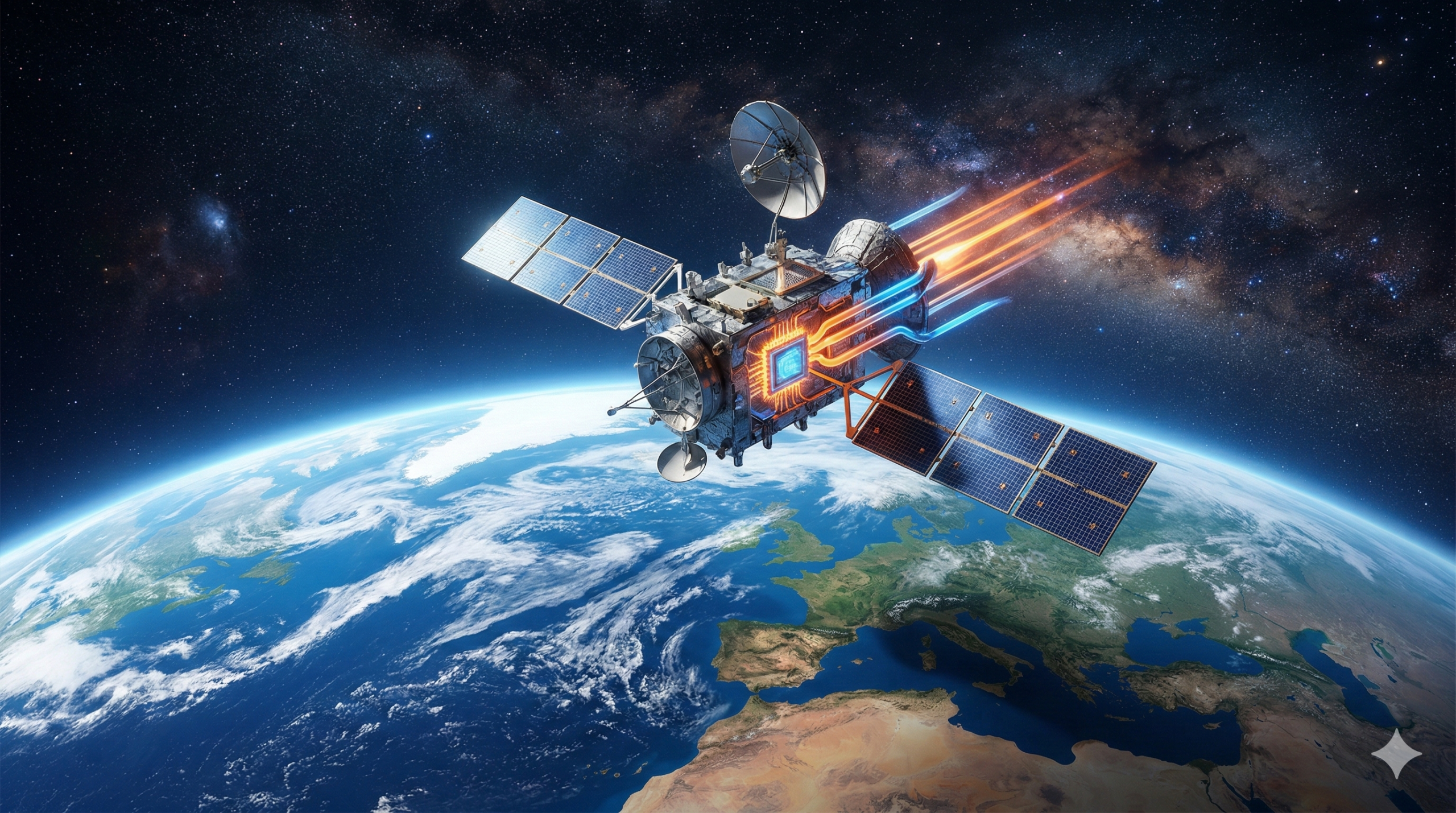
Diamond’s Orbital Dominance
While NVIDIA and Coherent are scaling AI on the ground, a parallel revolution is happening in Low Earth Orbit (LEO). As satellite constellations like Starlink and Kuiper grow, the demand for higher data throughput is pushing traditional Gallium Nitride (GaN) electronics to their physical limits.
1. The GaN-on-Diamond Breakthrough
Most modern satellites use GaN-on-SiC (Silicon Carbide) for their radio frequency (RF) amplifiers. However, as we push into higher frequency bands (Ka, V, and the upcoming W-band), these chips generate “hotspots” with power densities ten times higher than the surface of the sun.
The Diamond Solution: By replacing the SiC substrate with CVD Diamond, engineers can place the world’s best thermal conductor within microns of the heat source.
The Performance Jump: Experiments by companies like BAE Systems have shown that GaN-on-Diamond can handle 3.6x the power density of traditional chips. In space, this means a single satellite can do the work of three, or transmit at triple the bandwidth.
2. Radical Weight Reduction (The “Cost to Orbit” Factor)
In space, weight is money. Every gram of cooling hardware—fans (which don’t work in a vacuum), liquid loops, and massive heavy-metal radiators—costs thousands of dollars to launch.
Simplified Thermal Design: Because diamond spreads heat so efficiently, it reduces the need for bulky copper “heat spreaders.”
The 40% Rule: Industry estimates suggest that switching to diamond-enhanced power modules can reduce the overall weight of a satellite’s communication payload by up to 40%. This allows for smaller, “CubeSat” form factors to deliver “Big-Sat” performance.
3. Radiation Hardness: The Diamond Shield
Beyond heat, space is a “hostile neighborhood” of high-energy particles.
Intrinsic Durability: Diamond is one of the most radiation-hard materials known. Unlike silicon, which can “latch up” or suffer bit-flips when hit by cosmic rays, diamond’s tight atomic lattice is incredibly resilient.
Longevity: For deep-space missions to Mars or Jupiter, where repair is impossible, diamond-enhanced electronics offer a 15–20 year operational lifespan that traditional semiconductors simply can’t guarantee.
4. Coherent’s “Bondable Diamond” in Space
The recent launch of Coherent’s Bondable Diamond (January 2026) is particularly relevant here. This technology allows diamond to be “fusion bonded” directly to semiconductor dies with a 99% reduction in thermal interface resistance.
This removes the “thermal glue” (TIMs) that often dries out or fails in the extreme temperature swings of space (cycling from -170°C to +120°C every 90 minutes).
Summary Table: Diamond vs. The Field
| Material | Thermal Conductivity | Why it matters for Space |
| Silicon (Si) | 150 W/m-K | Standard, but fails under high heat/rads. |
| Copper (Cu) | 400 W/m-K | Excellent, but extremely heavy and bulky. |
| Silicon Carbide (SiC) | 490 W/m-K | Current space standard; reaching its limit. |
| CVD Diamond | 2,000+ W/m-K | The ultimate: 4x better than SiC, 5x better than Copper. |
