
LGDinTECH Insights: Episode 3
Unlocking Diamond's Technological Potential: Inside GIA's New Testing and Metrology Division
Gemological Institute of America (GIA) is stepping into the future of technology…
and it’s redefining what diamond can do.
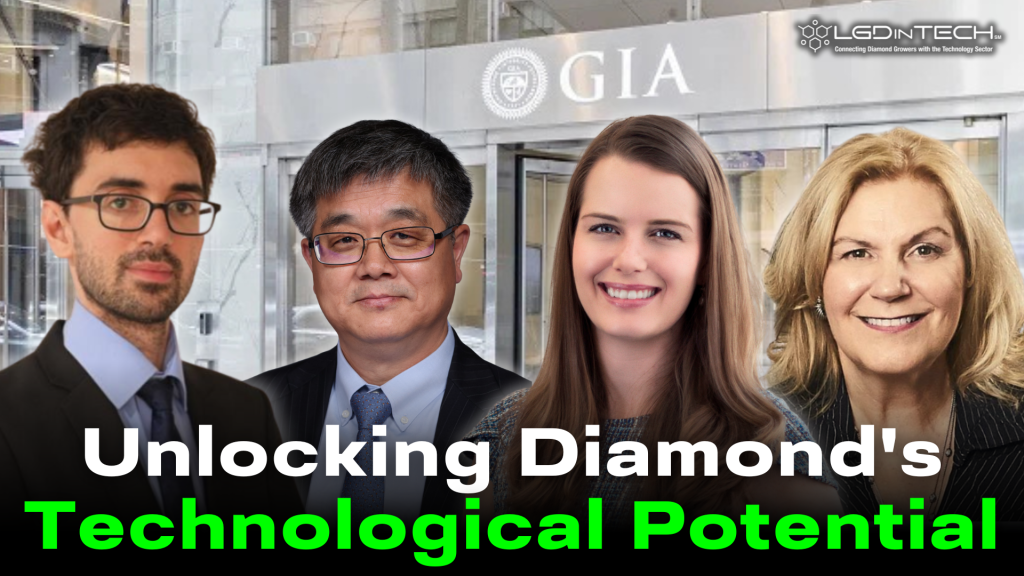
In our third episode of LGDinTECH Insights, Liz Chatelain sits down with GIA’s leading diamond scientists,
Dr. Wuyi Wang, Dr. Ulrika D’Haenens-Johansson, and Dr. Daniel Jones for an unprecedented deep dive into GIA’s new Testing & Metrology Division for Technical-Grade Diamond.
For the first time, GIA explains:
– Why they’re entering the diamond-for-technology space
– What pain points exist in today’s diamond material ecosystem
– How their metrology tools reveal defects, purity levels, NV centers, and optical/quantum characteristics
– Why advanced industries now require precision diamond analysis
– How GIA is enabling aerospace, quantum, photonics, semiconductors, medical devices, and more
– Their state-of-the-art techniques in analyzing diamond defects, characterizing material properties, and providing invaluable insights for technological applications.
This is the most detailed public discussion ever released about GIA’s new capabilities for lab-grown diamond used in technology – you won’t want to miss.
GIA Diamond Material for Technology Webcast Transcript
Dr. Wuyi Wang: I am Dr. Wang, Vice President of Research and Development at GIA. One of my main research interests is to study and analyze lattice defects in diamond. I’ve been working at GIA since 2000.
Dr. Ulrika D’Haenens-Johansson: Hi, I’m Dr. Ulrika D’Haenens-Johansson, the Senior Manager of Diamond Research at GIA, and I’ve been studying all the different aspects of diamond defects for the past 20 years.
Dr. Daniel Jones: Hello, my name is Dr. Daniel Jones. I’m a research scientist here at GIA and I’ve been studying diamond, in particular lab-grown diamonds, for 11 years.
Liz Chatelain: And I’m Liz Chatelain, and this is the LGD in Tech Insight Podcast. GIA (Gemological Institute of America) was established in 1931 and is the world’s premier authority on diamond. GIA is a nonprofit with a global presence and is the leading source of knowledge, standards, and education in the area of diamond. So we’re really fortunate today to have their three leading scientists here to talk about diamond, focusing on diamond material for technology, and just educating us more about diamond itself.
So let’s start. Lead scientist, Wuyi, briefly tell us why GIA is launching a testing and metrology division for technical-grade grown diamond.
Dr. Wuyi Wang: GIA is a world-leading institute in diamond research and laboratory services for both natural and lab-grown diamonds. We have over 60 years of experience studying lab-grown diamonds, starting actually from the very first HPHT synthetic diamonds by General Electric, which were readily analyzed by GIA to support the global jewelry industry. GIA has built up extensive instrumentation and expertise in diamond analysis and metrology. We know different advances in diamond synthesis technologies. The expanded availability in the last two decades means that diamonds are now on the verge of widespread implementation for technological applications, and there is a need to know diamond properties accurately, such as the impurities and defects. GIA is excited to help support this new stage.
Liz Chatelain: What pain points in today’s diamond for tech ecosystem does this solve?
Dr. Ulrika D’Haenens-Johansson: So GIA is uniquely situated with its expertise in both natural and laboratory-grown diamond analysis to provide a service to the industry. Many producers are trying to pivot towards growing diamonds for technological applications that notably have very different requirements. Most technological applications rely on the tailoring of properties of the material by careful defect engineering. Diamonds may, for instance, need to be ultra-high purity with nitrogen concentrations below certain thresholds, or conversely, desirable defects may be produced through controlled doping with or without subsequent treatment. The analysis of point and extended defects in diamond materials is the basis for GIA’s diamond identification criteria. Therefore, we can provide a method for the industry to gain valuable insight into their material, supporting a feedback loop for recipe development as they work towards meeting key specifications, as well as probing the homogeneity and reproducibility of their samples.
Liz Chatelain: Very interesting and the industries now are multiple industries, obviously for tech. Our group is focused on the 10 top industries, which includes aerospace, defense, high-powered electronics, laser systems, medical devices, microwave, optics, photonics, quantum of course, and semiconductors. So there are a lot of industries that you and the group at GIA are going to be interfacing with. It’s a very exciting time for everyone. Wuyi, let’s come back to you. How does the initiative relate to GIA’s mission of being a public benefit to the trusted trade, now applying this to semi, quantum, medical, which I just mentioned, that whole list?
Dr. Wuyi Wang: Our current focus at GIA has been on diamonds for the jewelry industry, but our expertise and equipment in diamond analysis and associated defects allow us to enter this emerging field with confidence. For diamond materials to reach their full technological potential with clear benefits to the public, the industry requires a solid foundation and an understanding of the properties of their products. Trust obviously is the key to any analytics service, and GIA has a reputation built on trust. Internal processes are set up to ensure unbiased and calibrated measurements are made by scientists who have an unparalleled understanding of diamond physics and the scientific metrology.
Liz Chatelain: Very true. We’ve interfaced with GIA for decades and you are basically the premier institution around the world, and all your offices and labs really have helped the entire gem industry. So now switching to tech, I think they can expect the same type of high quality interface and research and maybe training in the future. So it’s going to help everyone. Just as a follow-up question, what unique capabilities or neutrality does GIA have that this market doesn’t have so far, the tech market?
Dr. Wuyi Wang: Well, to serve the global jewelry industry, in particular to separate natural diamonds from treated natural diamonds and to separate the natural diamonds from lab-grown, or synthetic, diamonds, we at GIA have an unrivaled combination of equipment ranging from microscopy to spectroscopy, all under one roof, providing a multifaceted approach to understand not just the properties of the samples, but also the evolution of the product. We have a team of PhD-level scientists such as Dr. D’Haenens-Johansson and Dr. Jones, who specifically hold PhDs in diamond physics, as well as postdoc fellows, research associates, research technicians, and engineers who conduct global research and develop various instrumentations.
Liz Chatelain: Well, all of that is going to be much needed by all these different industries. So back to you for a second, Ulrika. So what specific testing and metrology services will be available at launch and then in the near term coming up, let’s say in the next year or two?
Dr. Ulrika D’Haenens-Johansson: So with diamond, we’re not always striving for perfection. We like to think of diamond as being a perfect material, but at GIA, we are truly passionate about the defects. They’re what make them interesting to us. Defects may sound like a bad thing, but they’re the foundation of many of the technological applications for this material. For instance, the Nitrogen Vacancy (NV) Center has attracted enormous attention due to its potential uses in quantum sensing and communication. And GIA has a suite of techniques to probe the presence, absence, relative concentrations, and distributions of both point and extended defects in diamond. Obviously, please do contact us if you want to receive a full summary of our capabilities. I’m just going to touch upon a few of these now.
Defects in diamond can interact with incident light through a variety of processes which can allow their detection. For instance, several defects in diamond result in absorption in the UV, visible, and infrared range, and spectroscopic methods may reveal their presence and concentrations. Absorption spectroscopy is key for evaluating diamond for optical transmission applications. Incident light may also excite defects who then emit light, known as luminescence. We can detect these defects through high-sensitivity spectroscopic techniques, such as photoluminescence, as well as deep UV fluorescence imaging, which can reveal their distributions and the intrinsic growth patterns and materials.
Secondly, we have electron paramagnetic resonance or electron spin resonance, which is sensitive to defects in diamond with unpaired electrons including isolated nitrogen. Now, this is a key measurement for ultra-high purity diamond, and we routinely use EPR at GIA to quantify nitrogen concentrations below one part per billion atoms (PPB), so very, very high sensitivity. And then these materials can obviously be further characterized using optical microscopy under a range of different lighting conditions. Imaging between cross-polarized light provides a route for strain visualization, and differential interference contrast imaging and scanning electron microscopy reveal topographic information. So by combining all of these different techniques, we get a really thorough representation of the quality of the material and the defects that are present within, so we get the full story through this.
Liz Chatelain: That’s amazing. So you have all this equipment now to be able to do this. Are they located in all your laboratories around the world?
Dr. Ulrika D’Haenens-Johansson: So a lot of the key features of absorption spectroscopy, photoluminescence, techniques like that, and imaging techniques we have scattered across the globe. Certain more specialized techniques such as electron paramagnetic resonance or the scanning electron microscopy, those are located in the United States.
Liz Chatelain: That’s great. So in a couple of years, what are you looking forward to adding to your abilities?
Dr. Ulrika D’Haenens-Johansson: Well, really the sky’s the limit. It depends on how this program develops. If there is a need, we will adapt towards it.
Liz Chatelain: Terrific. I’m sure there’s a lot of engineers and design techs out there hoping to hear that answer. Daniel, you’re not getting off the hook. Let’s ask you a few questions. So, GIA has an instrument development department. What capabilities do they contribute to this effort that Ulrika was just explaining?
Dr. Daniel Jones: So, as most of my colleagues have previously discussed, diamond is a unique material with many challenges for characterization. Depending on the application, whether that be for a thermal solution, quantum sensing, or the biomedical field, custom instrumentation is required to get accurate and detailed information about these specific characteristics. This is also the case for GIA’s testing of diamonds of gemstone, where bespoke instruments have been developed by our in-house instrumentation group, by a team of engineers and scientists.
To that end, we have developed unique capabilities in mapping the distribution of diamond defects. Since homogeneity is important for certain applications, such as quantum sensing or optical window transparency, we have developed a high-resolution, three-dimensional hyperspectral imaging system, which non-destructively measures the distribution of photoluminescence defects, such as the NV sensor, within a diamond volume. And this is of particular importance to growers or application specialists which want to exploit the unique properties of diamond for a specific application where spatial distribution is important.
So in the following image, this is an example dataset for the three-dimensional hyperspectral imaging system that we have developed at GIA. And what you are seeing here is four cross-sections showing the total stone and then different cross-sections following either the X Y, X Z, or Y Z planes. And what this is showing is the evolution of this CVD diamond as it grew. This is very difficult to see with other techniques, and the colors basically correspond to different defects within the diamond, corresponding to different growth events. For instance, the red color is associated with growth interruptions, whereas the green color is the CVD diamond that was grown on top of the substrate, which here is shown in blue. At each pixel, we have a high-resolution spectra, which allows us to characterize the emitting defects in this volume.
The following video shows how this diamond evolved in the reactor, the step flow growth, as this is occurring in a CVD reactor, incorporating different concentrations of defects. As this diamond grew with varying conditions, we are seeing this growing up from the substrates into the reactor plasma itself. Growers need to be able to understand how their growth regime morphs over time during growth, and how that changes the incorporation of defects, in particular nitrogen, when growing pure materials. It becomes much more obvious when reactor conditions are changing, and this technique can help in understanding which changes are important to monitor and avoid during synthesis.
A significantly less measured property of photoluminescence is its lifetime, which you can think of as the time it takes for light to be emitted from the defect after excitation from the light source. This is useful as it can be used to evaluate the concentration of paired nitrogen in the diamond, something typically only possible with absorption at relatively high concentrations. Any facility which has this capability typically can perform it on bulk samples with no localization, with the rare ability to measure this as localized points. However, at GIA, we have developed the ability to measure this lifetime property in a three-dimensional volume to create localized 3D maps of this concentration. We are also expanding our capabilities to include absorption and Raman mapping, key for evaluating the optical transparency and strain properties across slices or wafers in high resolution. A particularly useful instrument that we’ve also developed in-house is a diamond inscription device capable of marking the diamond, which has applications in writing sample identification directly onto the surface of a diamond.
Liz Chatelain: Explain to us what can be used on single-crystal or nano-crystal or poly-crystal diamond wafers.
Dr. Daniel Jones: We routinely evaluate single-crystal diamonds produced for gem applications, whether they be natural or lab-grown. They often have varying shapes and sizes, where we can handle a variety of facet geometries and sizes from sub-millimeter to much larger samples. Some of our diagnostic techniques are also suited for investigating other forms of diamonds such as nano, micro, and polycrystalline diamond.
Liz Chatelain: Okay. Great. Because the growers out there now are growing both, and they’re all trying to reach larger sizes. So this is going to be very important to them. So just as a follow-up question then, what kind of samples are best to start with for a meaningful baseline evaluation? What should people be sending you?
Dr. Daniel Jones: So representative CVD or HPHT blocks or plates are typically the easiest to measure when using bulk analysis methods. The sample may need certain specifications such as substrate removal for CVD-grown diamond, or single sectors from high-pressure, high-temperature diamond. We will work directly with the clients to clarify these specifications to help ensure a smooth workflow.
Liz Chatelain: Let’s go back to GIA’s basic service, which is sometimes producing reports. What will your tech diamond reports look like? Will they have executive summaries? What are you visualizing here?
Dr. Ulrika D’Haenens-Johansson: So when it comes to gem diamonds, certainly we’ve had standardized reports for many, many decades. But for this particular program, at this stage, we’re interested in working with the producers and the application specialists to generate the information that they require. Each application focuses on different characteristics. They’re evaluated by different tests, so really a one-size-fits-all approach is not feasible at this stage. This is an exploratory program that will be bespoke with a catalog of techniques for consideration, and then a summary will highlight the key properties and features as requested. And the raw data, be it spectra or images, will be provided as an appendix.
Liz Chatelain: Okay. So that’s good. And it’s repeatable. That’s the whole purpose, right? Is that you can evaluate a couple of diamonds or a million diamonds eventually. Exactly. Wuyi, let’s get back to you for a minute. What’s the initial intake volume? I know I just threw out the number of a million, and someday you’re going to get there, but what do you think the initial intake volume is going to be for this program, and what kind of turnaround time can your clients assume?
Dr. Wuyi Wang: Well, at GIA we have ten entries [locations] now all over the world. Actually, every year we test millions of diamonds anyway. For this service, we have a flexible capacity. I think we can easily support the analysis of tens to hundreds of diamond samples. That shouldn’t be a problem. It’s really dependent upon what the analysis is to be performed. The turnaround time, I think, is about one to two weeks, generally speaking.
Liz Chatelain: Okay. That’s good. So as a follow-up then, what will the pilot program look like? What’s the pricing? Are you assuming any academic discounting? Can startups have some type of discount to help support their development of the use of diamond material? What are you thinking?
Dr. Wuyi Wang: Yes, I think we will start with a pilot program, making it easy for our clients. The fee structure has not been finalized yet. We will include a discounted fee structure at the beginning. We will support academic research with flexibility.
Liz Chatelain: That’s terrific. I’m sure they’re going to appreciate that. And for growers and OEMs listening to this podcast, what’s the simplest next step to engage with GIA’s new service?
Dr. Wuyi Wang: I think the simplest way is just simply contact me directly. That’s probably the easiest way to get a discussion started. You can also contact Ulrika, Daniel, or other scientists in the GIA research department. You also can contact our GIA customer service or even contact GIA senior management. Either way is fine, but I think the simplest way is just contact me directly for now.
Liz Chatelain: Okay. Then we’re going to share your email address.
Dr. Wuyi Wang: Yes, please.
Liz Chatelain: So this has been terrific. Do you guys have any additional statements or information that we haven’t touched on that you’d like to share with the audience?
Dr. Ulrika D’Haenens-Johansson: The reason that we’re so excited about these developments is that they’re not just pretty pictures. As Daniel mentioned, each pixel has a full spectrum. You don’t just say, “Oh, it’s glowing this color.” You can actually say why it’s glowing. You’re understanding the defect structure within the crystal, and you’re doing this non-destructively. You don’t have to cut up your sample. You can just scan through the material and see what’s present inside.
Dr. Daniel Jones: And this is something uniquely generated at GIA. This is a purpose-built instrument which is unique in the world, something that only we have access to.
Liz Chatelain: Thanks to everyone, this has been really informative. I know everyone in the diamond material industry is very excited that GIA is taking the lead here and being able to service what basically we all needed, which is metrology and testing and really putting the uniformity together that we need, that everyone can rely on. And because of GIA’s multi-year background of being a worldwide specialist in diamond and having the public trust, it’s really the perfect institution to take this on. So I know that a lot of people in the tech industry are very excited about this. I wanted to thank everyone on the call today and to all of our listeners, thank you for listening. And if you want, again, to contact GIA, simply go to their website [GIA.org] and look up Diamond Research. You can find Dr. Wang there and you can email him directly. They’re all open to receiving interesting emails about people who want to know more, who want to start using the service, who basically don’t know maybe where they should be concentrating on preparing for the service. So all of that can be answered. It’s going into its pilot program right now. I know they’d be very excited to hear from you. And you should join LGD in Tech Consortium [LGDinTECH.org]. So LGD in Tech is now going into its third year. We have members all over the world, including GIA. Everyone who’s working with diamond material in the area of technology should join LGD in Tech. Please visit our website, lgdintech.org, and thank you for viewing.