
LGDinTECH Insights: Episode 4
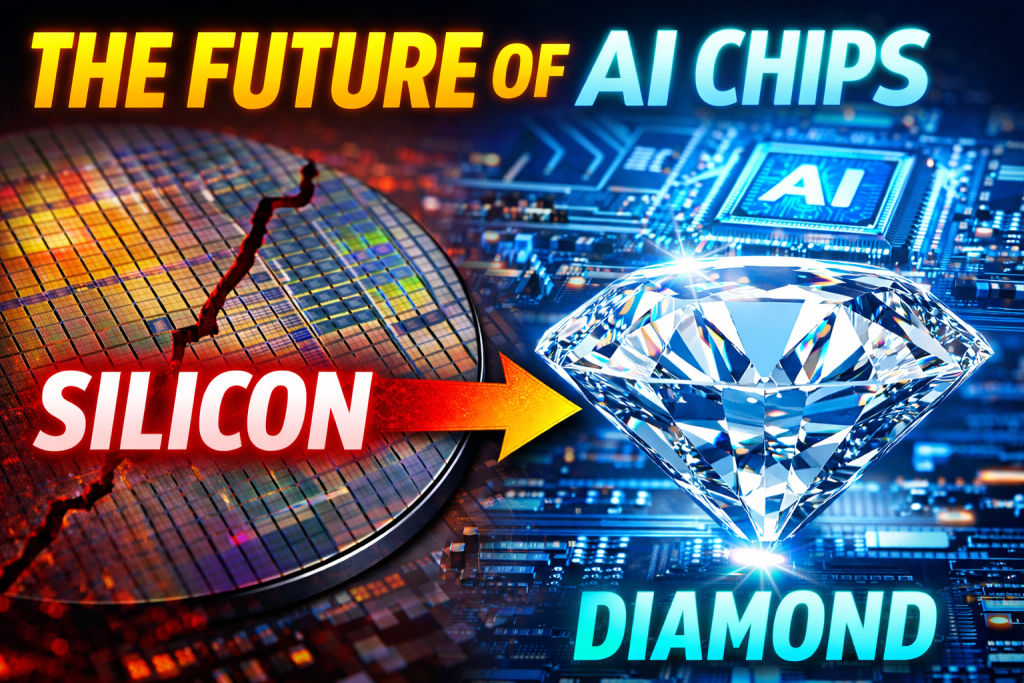
Why Diamond Is the Only Material That Can Keep Up With AI Chips
Diamonds aren’t just for jewelry anymore. They’re quietly becoming one of the most important materials in modern technology. Nano diamond is unlocking performance gains that other materials simply can’t match.
In this episode of LGDinTech Insights, Liz sits down with Wenjia Dong, VP of Navi Material, to talk about how nano and micron-scale diamonds are being engineered, classified, and deployed to improve polishing efficiency, surface roughness, thermal management, and product consistency.
From polishing silicon carbide wafers to enabling targeted drug delivery and next-generation heat management, this conversation breaks down why diamond is the only material that can keep up with today’s technology demands and why most people have no idea it’s already happening.
This episode is sponsored by Synova, the creators of Laser MicroJet technology for precision diamond processing. With Synova’s water jet guided laser technology, businesses worldwide can expand their processing capabilities, reduce costs, and achieve superior cutting quality, even when working with the most complex materials.
Learn more at Synova.ch
Podcast Transcript
Liz Chatelain: Hi, I’m Liz Chatelain, and this is the LGD inTech Insights podcast. Today we have a guest—really a company—that came to us very early when we launched our program. We were so thrilled that all of our early actors have really meant a lot to us, and they have really exceeded, I think, even some of their own expectations of how technology-grade grown diamond has really come to the forefront as a futuristic—really happening today—new material that is giving tremendously engaged industries solutions to their problems.
This episode is sponsored by Sunova. They’re the creators of the laser MicroJet process. It’s amazing. They use water with the laser system and they create a hair-thin cut where they need to. They’re a very advanced laser company, and frankly, the envy of a lot of other companies. Learn more about Sunova at their website, Sunova.ch—when light meets water, magic happens.
That’s terrific. So tell us about your nano product. How do you produce it, where does it come from, and how are industries using it to advance their own products?
Wenjia Do: It’s great to meet you again, and my name is Do. I’m from Navi Material. We focus on development and commercialization of tech-grade diamonds. Our company normally works with micro- and nano-size-scale diamonds. We make them into product and help our clients to improve their application, their efficiency in their products, especially in semiconductor processing, optics, and precision polishing.
Most of our customers are international—from Europe, the U.S., Japan, China, Taiwan. So for us, we hope that with our supply chain, we can help our clients around the world to make the chips better, now or in the future.
At Navi Material, we don’t normally focus on gemstone diamonds—those are the bigger ones. We focus on the nano and micro size. On the nano size we’re very good at nano diamonds; that’s where all our technology started. We use this material as a functional material. We work very closely with our clients, putting nano diamonds into applications—into silicon wafers, sapphire optics, and advanced ceramics where they use them for lapping and polishing.
A big part of our work is to help our customers to know where nano diamonds can work the best, how they can work the best, and then to optimize their particle size, morphology, and consistency on the products so our supply chain can be really stable, and then they can deliver stable product to their customers in the end.
Liz Chatelain: Well, how is nano diamond actually being used? So let’s say in the medical field.
Wenjia Do: In the medical field, nano diamonds can be used in a very wide variety of ways. For example, nano diamonds can be used as a target or carrier for medicine. When you take medicine, if you mix it with nano diamond, when you put the medicine in your mouth it will digest through your body, and then the nano diamonds will go with the medicine to wherever it goes.
In this case, scientists will know where those medicines go in your body. This will definitely help them to make better medical solutions in the future.
Liz Chatelain: Now, isn’t it also true with nano diamond in the medical field—especially when it involves drug delivery in the human body—that because diamond is carbon, there’s no rejection? Is that true?
Wenjia Do: That’s totally true. That’s totally a hundred percent pure carbon; it’s the same material as our body.
Liz Chatelain: I just find that so fascinating. So the other areas that nano diamond is used—it’s endless. Where are your customers using nano diamond the most?
Wenjia Do: My customers mainly use nano diamonds in silicon wafer polishing and sapphire polishing. As you know, nowadays chips are so popular. With all the AI going on, all the chips have to come through the silicon wafer, which is where all the chips start being produced.
When we deal with silicon carbide wafers, those are really hard materials. In order to process those wafers into a very fine and polished surface, we need a harder material—which leaves us with only one choice: diamond. Diamond is the only material that’s harder than silicon carbide.
So in order to reach a better surface polishing result, we need to use particles as small as possible and as well-classified as possible. In this case, nano diamond is introduced into this process. Nano diamonds can provide a strong polishing result, a good removal efficiency, and, most importantly, they can deliver a consistent product to the downstream customers.
Liz Chatelain: That’s right. I mean, even when they polish diamond—for any reason, whether in deep-tech applications or for gem use—they use diamond on diamond to polish it, because nothing else will polish a diamond. That’s how hard the material is. So it’s really expanded now that it’s more in tech, and we are concentrating on the ten major tech industries to help them start exploring and utilizing diamond—nano diamond, diamond wafers, substrates, whatever they need.
Those industries include aerospace, defense, high-powered electronics, laser systems, medical devices—which we talked about—microwave, optics, photonics, semiconductors, and of course quantum, which is really going to reach its best level because of the use of diamond. So it’s all really exciting.
Where is your product grown, and where is it produced into nano diamond?
Wenjia Do: Our diamonds are mainly from China. Personally, we don’t grow our own diamonds. We source different types of diamonds from our upstream clients. In that case, we help our clients manufacture them into different types of shape and morphology, and we help them to classify, to reshape, and to make them into a better solution for them. We add value to their diamonds too.
For example, one of our clients has tons of diamond that they don’t use. We make them into agglomerate diamonds that can add value to their product. In this case, their overall operational cost will decrease and it will give them more freedom and liquidity to go further beyond their current research.
Liz Chatelain: That’s great. Where do you see the roadblocks? When you’re trying to convince people that nano diamond—or any diamond—is really an advantage over other materials, or even enables them to do things they never thought they could do in deep tech, where are you seeing the roadblocks in your work?
Wenjia Do: The main roadblock is the validation cycle. As you know, Liz, in this industry all the companies are very cautious with their products because they are one of the factors in the whole supply chain. If they make a mistake, the whole supply chain will have an issue. So they have to be very careful, which we totally understand.
We are very cautious about what we provide and what we suggest to them. For some of our clients, we have to have very mature communication with them before we suggest what type of nano diamonds they can use or which scenario they should use them in. Even in this case, we have to give them samples and run sample testing again and again to see if that is really the case.
For us, we don’t know exactly what their manufacturing scenarios are and how detailed they can go with it. So for the testing, it can go for one or two years, combined with all the communication. That’s kind of a long-term run for developing clients. I think that’s a roadblock on our end because the feedback tends to be long, but as long as we establish the communication and connections, we can work together on future products and future applications, which we believe can optimize this process.
Liz Chatelain: That’s very exciting. Let’s go back to when we first met and you first joined LGD inTech. Do you think working with LGD inTech has helped illuminate the possibility of all sorts of grown diamond material in deep tech?
Wenjia Do: Yeah, I totally believe that. I truly believe that LGD inTech is one of the most important members in the diamond industry, especially in industrial diamond. I always say there should be a group of people that lead the development of this industry.
As I said, the roadblock is the validation cycle, and that’s partly because we don’t have mature communication. We’re all very cautious about the quality of the products we provide and about their applications. If LGD inTech, as a member in the industry, can bring all of us together into the same group, we can learn from each other and know each other better. When the information becomes more transparent, it gives us a much better chance to move things faster and move the industry faster overall.
Even though diamond is a small part of the long supply chain, the faster this part can go, the faster the overall supply chain can go.
Liz Chatelain: I agree with you. LGD inTech is going into its third year, and when we first launched there were so many industries where even scientists within their own industries didn’t really understand the possibility of grown diamond and that it is economical.
Even when the few companies were venturing into it over the last ten years, pricing was a major roadblock. Now the pricing has come way down—to literally, you know, ten percent of what it used to be. So it’s much more accessible. There are many more companies interested in working with different tech companies to perfect what the client needs and then be able to provide that on an ongoing and secure basis.
So that’s terrific. It’s been evolving very quickly and it’s still just getting started.
Wenjia Do: We want to take a quick break to thank Sunova, the creators of laser MicroJet technology, for being a sponsor. With hundreds of systems installed worldwide and all-Swiss-built engineering at the core, Sunova is trusted where precision really matters.
Liz Chatelain: Learn more about Sunova at their website, Sunova.ch—when light meets water, magic happens.
So I have another question for you. The last time I saw you was at Semicon West in Phoenix a couple of months ago, and you were talking about some new products that you were developing. It wasn’t in the nano diamond area, but it concerned diamond. Can you give us a little more info on that?
Wenjia Do: Yeah, definitely. I remember last time we talked about the diamond balls, which are spherical diamonds. We make them into a very high sphericity. As we know, the total sphericity is 1, and we try to make them into 0.95, even higher to 0.98, which is very close to a perfect circle.
In this product, we’re not only aiming at the market for diamond tools like grinding tools and diamond knives; we’re also trying to put this diamond into heat-management gels. Those are a future direction for industry. As we know, diamond is a perfect material for heat management—it’s the best material in the world in that aspect. It’s much better than copper or aluminum.
We’re thinking to make them into a gel shape and maybe some solution shape so that in the future we can put them into semiconductor applications, and in this case we can improve heat management quite a lot.
Liz Chatelain: Yeah, heat management is a huge issue for many different industries.
Wenjia Do: Yeah, that’s one of the targets we’re aiming at. Since last year I was at a ceramics show—which was funny, because they put a ceramics show and a heat-management show together. I felt that with the progress made in the semiconductor field—as we heard, Nvidia had a problem with their heat management in their chips, and they hadn’t been solving it for, I remember, six months, which delayed their chips quite a lot—I believe that diamond, as a perfect material in this aspect, should be used more.
On heat management, diamond can definitely be used as a perfect material in this application. Nowadays I can see that in China there are more and more companies trying to aim at this field, especially in the southern part of China. During the past two years I feel like there are more companies trying to develop new types of diamond heat-management materials—diamond gels, diamond products—to help this industry.
Liz Chatelain: Interesting. Very interesting. We’re going to keep our eye on that.
Wenjia Do: Definitely. I think that’s one of the most popular topics right now in the industry. And they’re using spherical-shape diamonds, which is what we’re producing. That’s why even though the new diamonds—the nearly perfect spherical diamonds—we’re making are still in limited quantity, we can see there are more and more customers pursuing, for example, 0.90 or 0.93 sphericity diamonds for heat-management use.
Liz Chatelain: Interesting. Okay, very good. So, as we all know, the big show is coming up soon, and another encounter with you was at the last show. People were asking about how you were working in diamond to help them solve problems. Can you give us a little more info about that too, on the optics side?
Wenjia Do: Definitely. The funny thing is that I also went to SPIE in Rochester. They have another show there. I met with a couple of people from some big firms. They produce a large amount of sapphire glasses, and as we heard, they use tons of diamonds.
We introduced nano diamonds to them and they’re very interested in how nano diamonds can be used in polishing and finishing. They’re quite happy that there’s progress in the nano diamond field, and that better classification and better shape of the diamond can definitely lead to a better result in their surface roughness and removal rate on their sapphire production.
As you know, sapphire can be used in a wide variety of applications. It can be used in optics, lenses, aerospace, and many other fields, too. With the development of all those industries, the increase in demand for sapphire lenses is quite dramatic, and I believe that the application of diamond in this field, especially nano diamonds, can be a real game changer in the future because it definitely provides good surface roughness and good removal rate compared to other materials. That’s the point that makes all the science-development people very interested in our product.
Liz Chatelain: That’s very true. Sapphire has been a terrific material, but when sapphire is polished with nano diamond, it becomes superior. Between optics and photonics and laser systems—really everything with a window—there is a need for extraordinarily accurate polishing ability, and it hasn’t really been easy yet. But it’s getting easier every day with the introduction of diamond, especially nano diamond wheels.
Wenjia Do: Yeah, definitely. All the customers are pursuing better Ra and better removal rate. Ra means surface roughness. The only thing that can achieve both is nano diamond—better-classified nano diamonds.
Liz Chatelain: That’s right. So it’s really helping—even as just a side tool—it’s really helping other products reach their ultimate capacity. It’s very exciting.
Wenjia Do: Definitely. That’s definitely the future of the industry.
Liz Chatelain: Do you have anything to add for us before we sign off?
Wenjia Do: After I’ve been communicating with Marty and Liz, you guys are terrific people. I really appreciate the opportunity. Every time we talk, it’s fantastic. I hope that in the future I can contribute to this industry even further.
I believe this industry has a really bright future because, for example, diamonds can be used in wafers in the future too—not only silicon carbide, not only silicon. Currently some companies are using diamond to manufacture wafers, which is a next step for the future.
Diamond will be a major player in the semiconductor field. Even though right now it’s already an important layer, in the future it will be one of the top players. So I truly believe this is the trend of the industry, and I truly believe that LGD inTech will have a very important role in the industry’s future.
Liz Chatelain: Well, thank you. We certainly appreciate your vote of confidence. The reality is that all these industries—maybe especially the semiconductor area—are up against Moore’s law, and the only way to breach it and continue is going to be with grown diamond.
So it’s a big future. Thanks so much for being with us today. We’re going to check back with you every six months and see how it’s progressing. How does that sound?
Wenjia Do: That sounds great, Liz. Thank you so much.
Liz Chatelain: Great. Alright—safe travels, my friend.