
Quantum Leap in Pharma
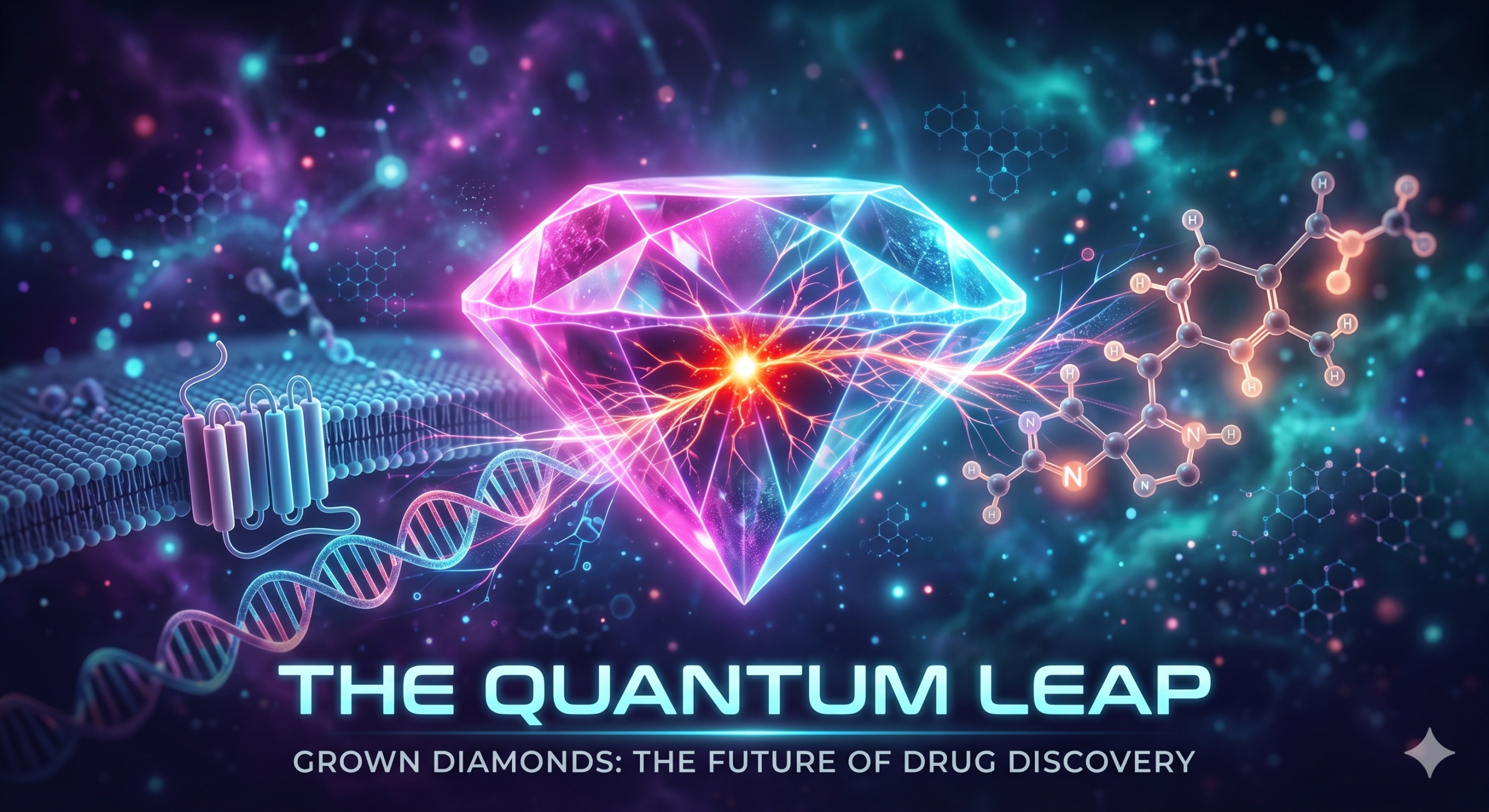
Why Technology-Grade Grown Diamonds are the Future of Drug Discovery
The pharmaceutical industry is currently facing a “resolution” crisis. While we have more data than ever, our ability to observe the microscopic dance between a drug and a human cell in real-time has reached a ceiling. Traditional fluorescent tags often bleach under intense light or fail to capture the subtle electromagnetic shifts that signal a drug’s success or failure.
Enter the Nitrogen-Vacancy (NV) center—a atomic-scale defect in a diamond’s carbon lattice that is transforming the lab-grown diamond (LGD) from a luxury gemstone into the world’s most sensitive quantum sensor.
The Physics of Precision
As highlighted in recent reports from AZoQuantum, the breakthrough lies in how we “grow” and “process” these stones. Unlike natural diamonds, which contain unpredictable impurities, technology-grade diamonds are grown via Chemical Vapor Deposition (CVD). This allows scientists to control the environment at an atomic level, deliberately introducing nitrogen atoms and then using high-energy irradiation to create “vacancies” in the lattice.
When a vacancy pairs with a nitrogen atom, it creates an NV center. These centers act like tiny, glowing compasses. They are fluorescent under green light, but their brightness changes based on the surrounding magnetic field, temperature, or pressure.
Why LGDs are Disrupting Drug Discovery
For decades, studying G-protein-coupled receptors (GPCRs)—the targets for roughly 40% of all approved drugs—has been a challenge. These receptors are incredibly sensitive; they don’t just “turn on,” they shift and vibrate.
Grown diamond quantum sensors offer three specific advantages that traditional biotech reagents cannot match:
Infinite Stability: Unlike traditional bio-dyes, diamonds do not “photobleach.” They can be monitored for days or weeks inside a living cell without losing their signal.
Bio-Compatibility: Carbon is the foundation of life. These nanodiamonds are non-toxic, allowing them to interface directly with proteins and cell membranes without killing the host.
Real-Time Kinematics: Because NV centers respond to electromagnetic profiles, they can report the exact moment a drug molecule binds to a receptor, providing a “high-speed camera” view of molecular interactions.
The Opportunity for the LGD Industry
The shift from “gemstone” to “quantum sensor” represents a high-margin frontier for the CVD diamond industry. While the jewelry market fluctuates, the demand for isotopically purified diamond (Carbon-12)—the “cleanest” possible material for quantum coherence—is skyrocketing in the R&D sector.
Companies like Element Six, Adamas Nano, and Applied Diamond are already paving the way, but the “Quantum-Biotech” bridge is still in its infancy. For the LGD sector, the opportunity isn’t just in growing the stone; it’s in the precision engineering of the surface chemistry that allows these diamonds to attach to specific biomarkers.
The Road Ahead
There are still hurdles. Nanodiamonds can sometimes clump together in biological fluids, and maintaining signal stability in the “noisy” environment of a human cell requires rigorous material purity.
However, as we perfect the art of growing “quantum-ready” diamonds, we aren’t just making better jewelry; we are building the tools that will discover the next generation of life-saving medicines. The future of pharmacology isn’t just digital—it’s quantum, and it’s grown in a lab.
